Engineers are good at spreading information about recording techniques. In fact, most love to talk about recording as much as they love to make recordings. This magazine you're reading right now is an obvious example of that. The result is a folklore of recording techniques that's ever-growing and ever-changing. However, no two people hear sound quite the same way, so no two people use all the same techniques. Finding out why something works or doesn't work is fun, but it can take a lot of time. Often, there's no time. So if it sounds good, use it, and if it doesn't, don't.
That's very practical thinking. Most ideas passed around concern specific solutions to specific problems rather than broadly useful methods. An example of this is the topic of microphone techniques.
Microphones are sometimes like a voodoo art. Yet it's really just smoke and mirrors, and personal preference. For every person who likes dynamics on an acoustic guitar, there's another who thinks condensers are the way to go, and a third who knows those other two are crazy, because ribbons are IT. If they all get paid to do what they do, they're all correct.
There are badly made microphones, but microphones are not good or bad. Microphones have characteristics. Those characteristics are a function of how a microphone converts sound to electricity. There are certainly some variations in sound from one dynamic to another, but no dynamic sounds like a condenser or a ribbon. Each picks up sound differently because they each work differently. Using that information eases the confusion of endless combinations of microphone models and appli-cations. Just select a microphone "family".
The primary characteristics of a family will be the same for all the mics in it. Since the characteristics are a function of the pickup element, we should consider those elements first.
Condensers have an extremely light pickup element made of thin plastic with a metal coating a few molecules thick, resulting in a very flexible diaphragm. Almost no energy is needed to put it in motion, and it will move very fast.
Dynamics are somewhat the opposite. A dynamic is like a teeny tiny loudspeaker used in reverse and is very rigid. It won't move fast, and it takes a fair amount of energy to move it at all. Bongos from a close distance require a mic with a slow response, such as a dynamic.
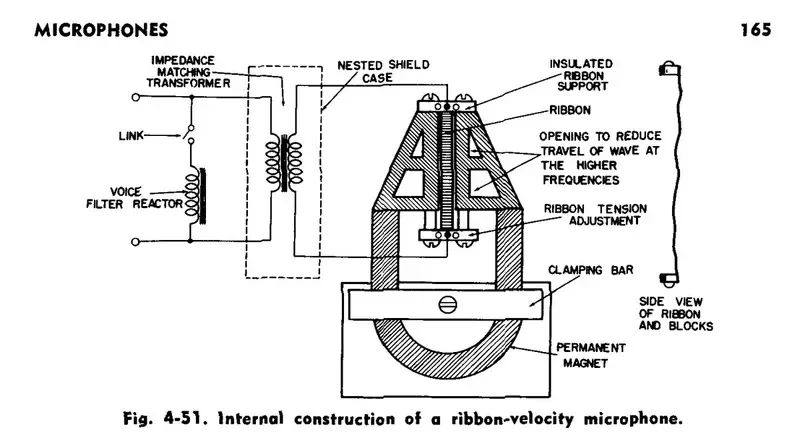
Ribbons don't have a diaphragm but instead have a corrugated aluminum ribbon, from around 4 inches to 3/8ths of an inch, hung in an extremely powerful magnetic field. The element needs very little energy to move.
According to legendary engineer Malcolm Chisholm, based on his experience and thought, condensers sound best on instruments with fundamentals in the 5 Hz to 12 kHz range, will react very fast to transient sounds, are terrible for isolation, and have a three dimensional pickup "balloon" of around 20 feet.
Dynamics are used for any instrument within the 80 Hz to 8 kHz range, will react terribly to transient sounds, have moderate isolation, and a balloon of 6 feet.
Ribbons are used for a 40 Hz to 9 kHz range, with a variable sensitivity to transients, extreme isolation, and a small balloon.
Bear in mind that none of these opinions are scientific, nor do they take into account the increased durability of modern ribbon mics.
According to Malcolm, ribbons are the "weapon of choice for live studio work", because, he theorizes, they "cancel out of tune distortion". He believes this is due to the ribbon reacting like a string in resonance to the loudest signal driving it. It is also ignoring everything else including stray noise, out of phase, and out of tune signals.
Furthermore, Chisholm states that the double ribbon design probably squares the effect and produces "phenomenal results", which makes them sound "so much like whatever's in front of them.
The reason for all of this reorganization of microphone specifications was because of the apparent lack of usefulness of the published specs that don't have anything to do with music so much as with sine waves. This isn't any fault of the manufacturers; there's just no practical way to test mics with music, so they only publish demonstrably accurate data.
So forget the models, forget the makes, and forget the specs. Just go by family and characteristics and keep it simple. As Malcolm would say, "This ain't rocket science."